📊 Daily Market Intelligence Report
Sunday, October 25, 2026
7:00 AM CST
📊 Top-Line Summary
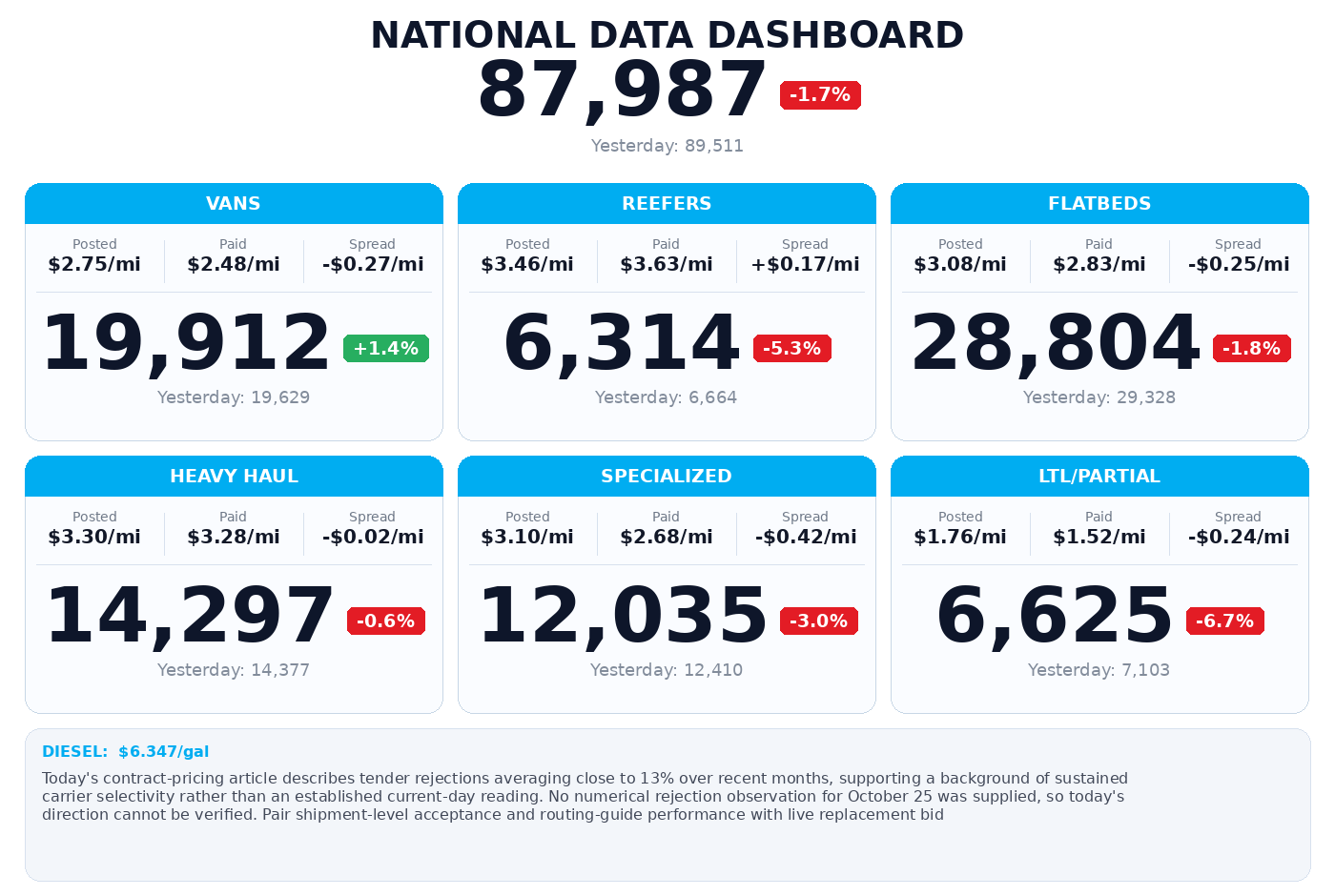
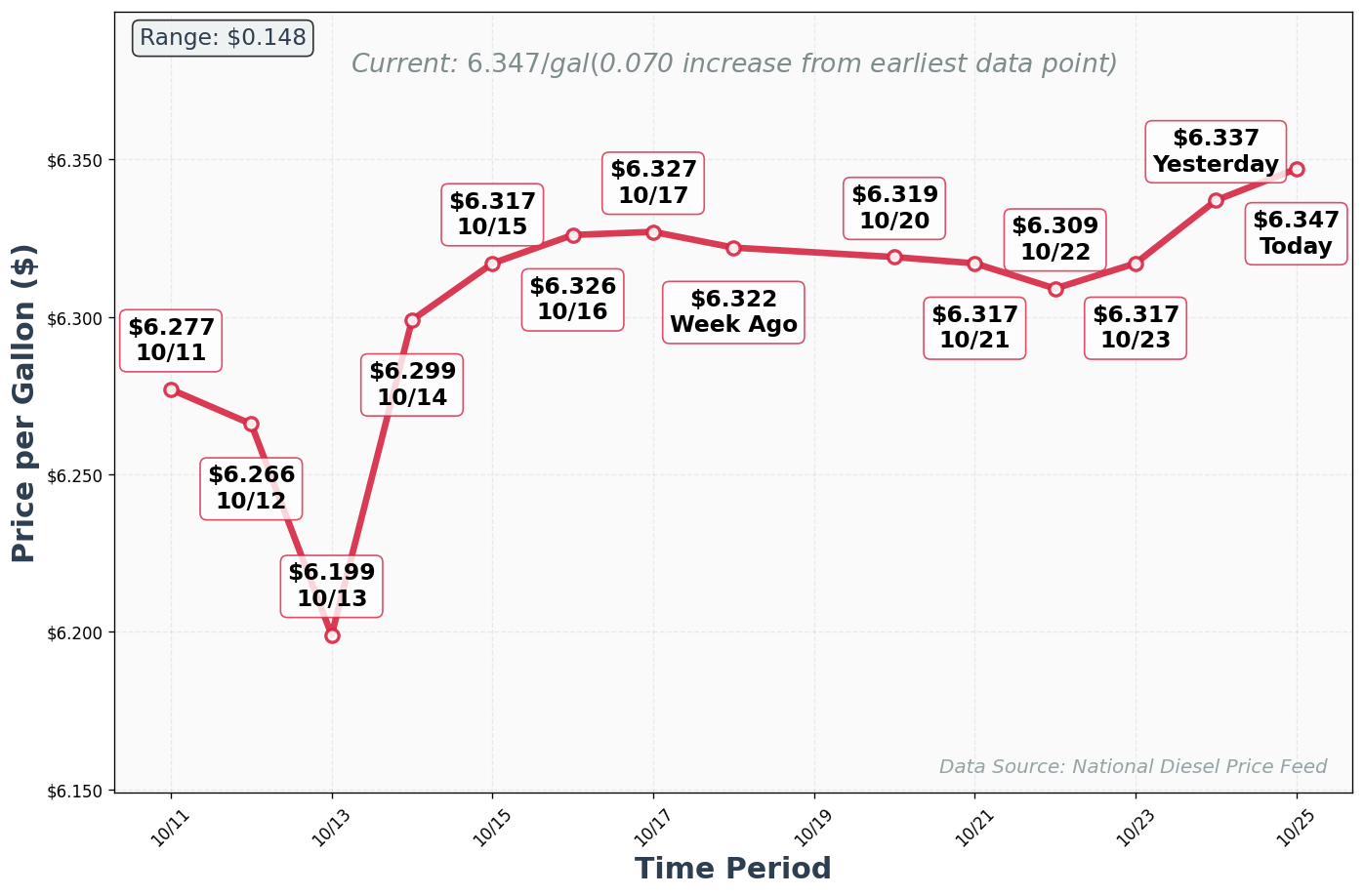
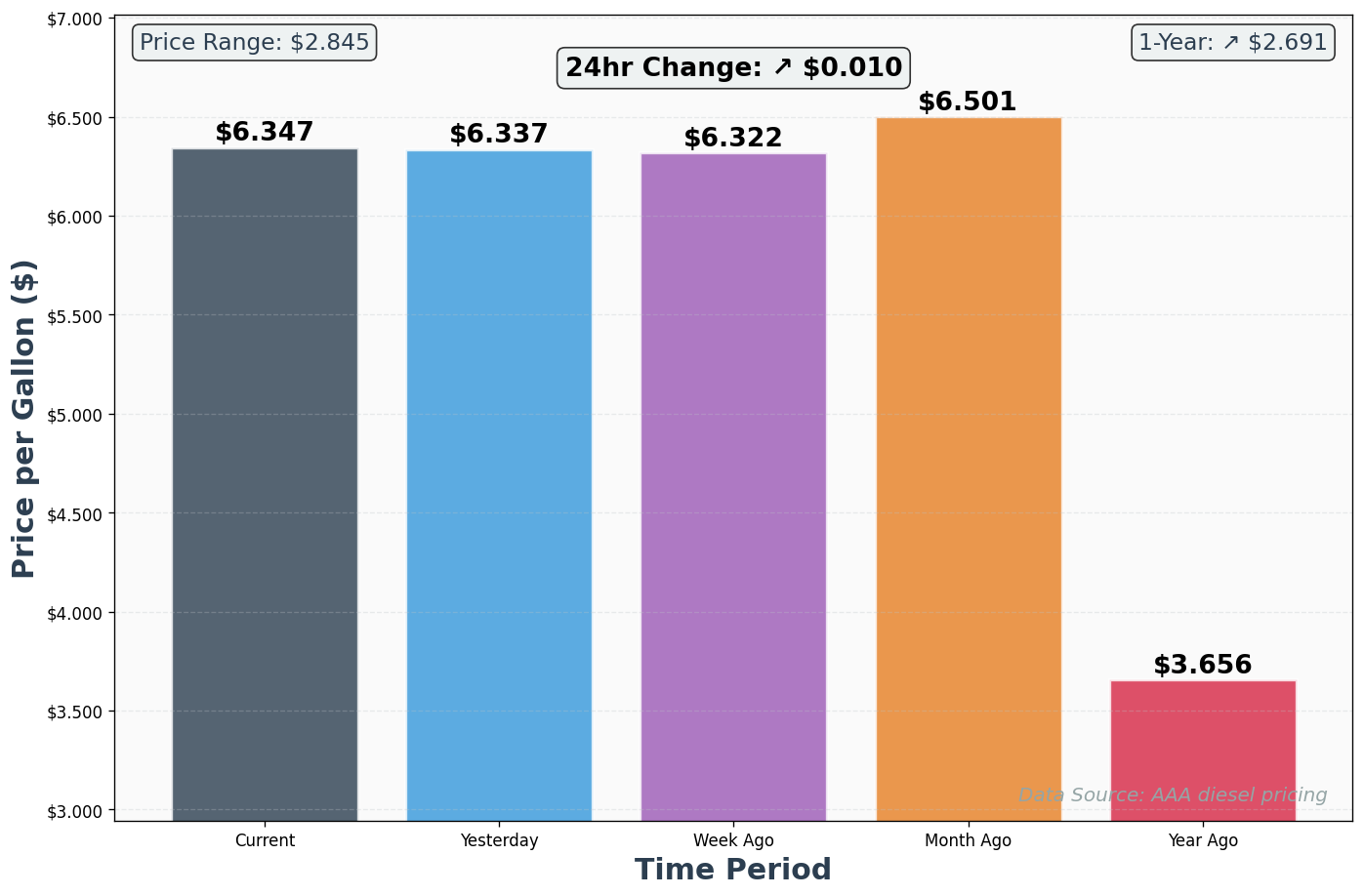
Refrigerated freight presents today's clearest pricing-risk signal: paid rates average $3.63/mile against $3.46 posted, even as available reefer listings decline 5.3% from yesterday. Van paid pricing has increased to $2.48/mile from $2.45 in the preceding report, while national available freight is down 1.7% and aggregate pricing has risen to $2.82/mile. This divergence favors equipment-specific procurement rather than a blanket tightening assumption. The Southeast remains a conditional commercial priority for North Carolina fall agricultural freight and distribution replenishment, with lane-level bids needed before committing margins. Diesel has already risen for three consecutive days to $6.347/gallon, its supplied recent high; weaker fuel futures suggest possible later cost relief, not immediate surcharge savings. Active Southwest flooding and localized Florida flooding require destination-level checks, while today's contract-pricing news supports disciplined replacement-cost discussions with shippers.
Insight
Price the empty miles before chasing a lower bid
At $6.347 per gallon, an additional 100 empty miles costs approximately $106 in diesel alone for a truck averaging 6 mpg, before driver time and maintenance. Compare carrier offers on total dollars and positioning time: a nominally cheaper truck farther from the packhouse can lose its advantage before loading, particularly when a missed appointment adds replacement-carrier exposure.
⛽ Diesel Price Analysis
Diesel Historical Price Comparison
🌦️ Weather & Seasonal Intelligence
Current Major Weather Events:
- Southwest regional flood warnings, including major flooding at Shiprock (Southwest States (NM, CO, UT), including San Juan County, NM): Flood warnings cover parts of the region, and the detailed Shiprock warning confirms major San Juan River flooding with gradual recession expected through Sunday. River-adjacent approaches and local pickup or delivery access could be unsafe or delayed; verify routing individually, and do not infer that I-25 or I-40 is closed from regional exposure guidance.
- New Jersey morning freeze warning (New Jersey (NJ, Middlesex, Mercer, Monmouth, Burlington, Ocean, Atlantic and Cumberland counties)): The warning calls for temperatures as low as 30 degrees and widespread frost through 9 AM EDT. Exposed temperature-sensitive freight and outdoor handling could require additional protection near I-95, I-195 and I-287; the alert does not establish icy pavement, highway closures or a general trucking capacity shortage.
- Moderate St. Johns River flooding near Astor (Florida (FL, Lake and Volusia counties near Astor)): The flood warning confirms moderate river flooding and identifies inaccessible local roads, with water levels forecast to crest Monday morning. Deliveries serving affected riverfront properties could require rescheduling or alternate access, but the warning does not establish closures of I-95 or I-10; screen destination addresses before applying broader Florida service premiums.
Weather Affected Corridors:
Weather Insight
Flood recovery follows different clocks
Shiprock's expected recession through Sunday and Astor's forecast Monday-morning crest create different dispatch decisions: verify access before releasing Southwest trucks, but secure a receiving-site contingency now for affected Florida deliveries. Drier Southwest forecasts into Monday favor recovery conditions, not automatic road reopening; residual flooding or damaged approaches can outlast rainfall. Require receiver confirmation of usable truck access before dispatching to either flood footprint.
💰 Financial Market Indicators
- Diesel Futures: NYMEX ULSD Dec 26 is $4.7870/gallon, essentially unchanged versus the prior close and down 2.71% over five trading days, as of October 23 at 16:59 EDT, the supplied latest trading quote for this Sunday report. Retail exceeds futures by approximately $1.56/gallon; that difference includes distribution, taxes, margins and timing effects and is not a guaranteed retail price decline. Because futures typically lead retail by several days, the weekly decline suggests potential moderation in carrier pump costs over the next one to two weeks if sustained, even though retail is currently rising. Fuel surcharges may adjust later according to their benchmark and reset schedule, so brokers should not promise immediate reductions or deduct the full spread from carrier costs.
- Carrier Financial Health: Today's contract-pricing article indicates that carriers resetting contracts are obtaining substantial increases, which may improve revenue quality, but this is not proof of stronger finances across all fleets. Diesel at $6.347/gallon keeps cash requirements and empty-mile exposure elevated, particularly for carriers without timely fuel recovery. No current financial statements, exit counts or consolidation transactions were supplied; assess individual carrier reliability, payment terms and sustainable round-trip economics rather than inferring sector-wide recovery.
- Economic Indicators: The supplied current article reports implemented contract resets averaging about 13% above the contracts they replace, while today's national spot average remains below its week-earlier benchmark. These measure different freight populations and do not establish a uniform inflation rate. Agricultural reporting also describes high fuel costs constraining ranch and farm economics, potentially influencing shipment consolidation and input-delivery decisions. No fresh manufacturing, consumer-spending or import-volume release was supplied to confirm a broader demand acceleration.
📰 Impactful News Analysis
-
Implemented truckload contract increases remain elevated 🔗:
The current article reports roughly 13% increases on contracts being reset, not on every shipment or the entire contract market. distinguish durable base-rate repricing from fuel changes when explaining replacement costs to customers, and validate each lane against executable carrier bids before extending quote validity. Existing carrier relationships and dependable pickup commitments may offer more value than aggressively advertising savings based on national spot averages. The reported lack of meaningful capacity growth supports monitoring routing-guide failures, but does not prove an October 25 shortage on any selected lane.
-
Federal driver-training oversight leadership transition does not change operating requirements 🔗:
Today's article announces the October 27 retirement of the official overseeing driver-training and related safety programs; it does not announce a new rule, enforcement waiver or immediate capacity removal. keep ordinary carrier qualification and compliance checks intact, avoid unsupported regulatory surcharges, and tell customers that no service change is established by the announcement. Monitor subsequent official implementation notices rather than treating a personnel transition as evidence of tighter driver supply.
-
Oregon ranch reporting highlights fuel-sensitive agricultural transport 🔗:
The article describes drought-related feed needs and high diesel costs adding pressure to Oregon ranch economics, but supplies no verified freight-rate or shipment-volume series. qualify hay and agricultural-input opportunities against actual purchase orders, suitable equipment and delivery access, with fuel and empty mileage clearly itemized. Positioning compatible return freight may help carrier economics, while customer budget pressure makes unsupported accessorial assumptions especially risky. Do not convert the article's drought and fire discussion into a current road-closure or weather-alert claim.
🗺️ Regional & Lane Analysis
📍 Primary Region Focus: Southeast United States
The Southeast is the strongest conditional commercial focus in the supplied context because North Carolina fall sweet-potato shipping and distribution replenishment offer distinct agricultural and general-freight customer pools. Today's national reefer paid-rate premium makes appointment-controlled refrigerated movements particularly important to price carefully, while van listings and paid pricing both increased from yesterday. These are national signals, not proof of regional tightness or lane-specific premiums. Concentrate prospecting on confirmed packhouse releases, food distribution and retail replenishment, using round-trip carrier economics to establish whether an opportunity is actually profitable.
🛣️ Key Lane Watch
Raleigh, NC → Atlanta, GA: Use Raleigh as a commercial gateway for prospecting surrounding North Carolina agricultural origins, with actual farm or packhouse pickup mileage quoted separately. The supplied October context identifies sweet potatoes as a relevant commodity, while today's national reefer paid average of $3.63/mile exceeds the posted average by 17 cents. This supports caution on refrigerated procurement but does not establish a current Raleigh–Atlanta rate or truck shortage. Commodity-specific temperature, ventilation and equipment requirements must be confirmed rather than assuming every sweet-potato shipment needs the same refrigerated service.
Atlanta, GA → Orlando, FL: This is a conditional distribution-replenishment prospecting lane rather than a verified current pricing hotspot. National van paid pricing is $2.48/mile versus $2.75 posted, with listings up 1.4%, suggesting a different procurement environment from refrigerated freight. Late-October retail and grocery distribution provide a seasonal demand hypothesis, but actual shipment releases and regional truck supply are not supplied. Flooding near Astor is a destination-access consideration for affected addresses, not evidence that Orlando's interstate approaches are closed.
Regional Insight
Friday is the month-end scheduling pressure point
October 31 falls on Saturday, making Friday, October 30 a potential concentration point for customers that close receiving over the weekend or require delivery before month-end. For Raleigh–Atlanta and Atlanta–Orlando freight, distinguish a Friday pickup requirement from a Friday delivery requirement before buying expedited coverage. Confirm weekend receiving now; a cheaper Friday truck can become an expensive holdover if unloading slips to Monday, November 2.
Regional Insight
A reefer reload must fit the preceding commodity
For North Carolina sweet-potato moves into Atlanta, qualify the proposed grocery reload before crediting any backhaul savings. Different temperature instructions, cleaning requirements or trailer preparation may add unpaid turnaround time between loads. Build the reload appointment around unloading and any required equipment transition, rather than assuming the trailer becomes immediately available at delivery.
📊 Fewer Listings, Higher Daily Average: A Mixed National Signal
Today's snapshot contains 87,987 available loads, down 1.7% from yesterday, while the market average increased from $2.78 to $2.82/mile. Against the week-earlier benchmark, listings are approximately 3.4% lower and average pricing is four cents lower. These observations support a mixed market interpretation rather than a uniform tightening or weakening narrative. The equipment averages show substantially different pricing relationships. Specialized posted pricing exceeds paid pricing by 42 cents per mile, followed by van at 27 cents, flatbed at 25 cents and LTL/partial at 24 cents. Heavy haul is nearly aligned at a two-cent difference, while reefer reverses the relationship: paid pricing exceeds posted pricing by 17 cents. Because these are unmatched averages, differences may reflect equipment specifications, shipment geography, mileage or timing rather than executable brokerage spreads. The reported opportunity measure declined to $162.5 million from $167.6 million yesterday. It describes the supplied market measure, not brokerage earnings. Likewise, 5,502 recorded movements at the snapshot cannot be treated as full-day throughput or compared uncritically with a different day's activity accumulation. No truck denominator is supplied, so a load-to-truck ratio or direct capacity balance cannot be calculated.
🚛 Reefer: Paid Pricing Separates From Advertised Levels
Reefer is today's most distinctive equipment signal. Available listings declined from 6,664 to 6,314, while paid pricing increased from $3.30/mile in the preceding report to $3.63. Posted pricing moved slightly lower, from $3.47 to $3.46, leaving paid pricing 17 cents above advertised pricing. This divergence suggests procurement friction or a more expensive executed shipment mix, but the data cannot isolate the cause. The supplied October commodity calendar identifies apples in Washington, New York and Michigan; cranberries in Massachusetts and Wisconsin; sweet potatoes in North Carolina and Mississippi; and grapes in California. These provide a seasonally consistent context for dispersed temperature-sensitive freight demand. The separate spring-transition characterization conflicts with the report month and therefore does not substantiate an October demand claim. The current evidence does not establish which origin has the tightest refrigerated truck supply, nor does it provide comparable lane rates or driver counts. A national paid-rate increase alongside fewer listings could reflect urgent shipments, route composition or equipment requirements rather than a nationwide capacity contraction. Confirmation would require repeated like-for-like transactions and shipment-level acceptance observations.
📰 Breaking Down: Implemented Contract Increases Remain Above 10%
Today's contract-pricing article reports that contracts being reset are increasing by roughly 13% relative to the rates they replace. The measure concerns implemented changes within established shipper-carrier relationships after an extended period of unchanged pricing. It is not an annualized inflation measure, does not represent every contract and does not directly measure freight volume. The article links these increases to sustained rejection pressure and reports that capacity has not grown meaningfully despite higher rates. This suggests that improved pricing alone has not yet produced a rapid supply response. However, the reported rejection average describes recent months rather than an independently supplied October 25 observation, and the contract measure cannot establish today's spot rate on a particular corridor. Today's spot snapshot provides a useful contrast: the national average is four cents above yesterday but four cents below the week-earlier benchmark, while refrigerated paid pricing has increased sharply from the preceding report. This does not contradict contract repricing because the measures cover different transactions, equipment mixes and adjustment periods. Together, they point to segmented pricing pressure rather than a single rate direction across all freight.
Strategic Takeaways
High-Signal Additions
- Confirm Friday delivery deadlines and weekend receiving before committing month-end capacity.
- Treat flood recession and confirmed truck access as separate milestones; arrange contingencies for affected Astor deliveries before Monday's crest.
- Count reefer backhaul savings only after commodity compatibility and trailer turnaround are verified.
- Compare total-trip costs, including empty miles, rather than selecting carriers on loaded-mile pricing alone.
🔑 Executive Signal Summary
- Protect refrigerated commitments first; negotiate flexible vans selectively. Reefer paid pricing of $3.63/mile exceeds posted pricing of $3.46/mile. That is a procurement-risk flag—not proof that every refrigerated lane is tight.
- Do not turn fewer listings into a nationwide capacity story. Available freight totals 87,987 loads, down 1.7% from the comparable snapshot. Without truck availability, this does not establish whether qualified capacity is becoming scarce.
- Make Southwest flood exposure a dispatch gate. The supplied warnings include expected catastrophic flooding along the San Juan River between Four Corners and Mexican Hat. Check affected routes, facility approaches and incoming trucks before release.
- Sell Southeast execution, not an unsupported regional premium. North Carolina agricultural freight and Atlanta-area distribution remain conditional prospects. Exact origins, commodity requirements and receiving windows determine whether they are profitable.
- Use Sunday to remove Monday dependencies. Confirm receiving, equipment readiness, preceding deliveries and recovery options before the desk becomes busier.
- Keep fuel exposure explicit. Diesel at $6.347/gallon makes empty positioning expensive. Lower futures offer possible later relief—not a discount on today’s carrier purchase.
📊 Buying Board: Where to Spend Procurement Attention
| Equipment |
Available loads |
Posted average |
Paid average |
Today’s buying posture |
| Van |
19,912 |
$2.75/mi |
$2.48/mi |
Test qualified alternatives where appointments permit |
| Reefer |
6,314 |
$3.46/mi |
$3.63/mi |
Secure service-critical equipment before seeking marginal savings |
| Flatbed |
28,804 |
$3.08/mi |
$2.83/mi |
Compare complete loading, securement and unloading scope |
| Heavy haul |
14,297 |
$3.30/mi |
$3.28/mi |
Resolve configuration, permits and movement windows first |
| Specialized |
12,035 |
$3.10/mi |
$2.68/mi |
Match exact equipment subtype and handling requirements |
| LTL/partial |
6,625 |
$1.76/mi |
$1.52/mi |
Validate space, compatibility, handling and appointment economics |
- Use the $2.82/mile national average as context—not a purchasing target. Equipment, geography, distance and shipment requirements differ materially.
- Do not interpret posted-versus-paid differences as available brokerage margin. These are unmatched averages, not paired shipper revenue and carrier cost.
- Allocate effort by failure exposure rather than listing count. A single uncovered refrigerated appointment can warrant more attention than several flexible van shipments.
- Keep equipment-specific conclusions separate. Reefer pricing pressure does not justify automatically increasing van, flatbed or specialized quotes.
⏱️ First 90 Minutes: Build a Bookable Shipment List
Rank uncovered freight by the latest safe booking time.
- Put temperature-sensitive freight, fixed receiving appointments, flood-exposed movements and permit-dependent loads first.
- Identify trucks whose availability depends on an unfinished delivery.
- Assign a named owner, escalation deadline and qualified recovery option to each exposed shipment.
Confirm four facts before negotiating price.
- Exact pickup location and actual freight-ready time.
- Written equipment and commodity requirements.
- Receiver appointment, staffing and usable truck access.
- Carrier location, equipment readiness and remaining HOS (Hours of Service).
Separate executable capacity from conditional offers.
- A truck awaiting unloading, washout or a driver assignment is not equivalent to a ready truck nearby.
- Record the condition attached to each offer and when it must be resolved.
- Do not tell a customer coverage is firm while a critical operating dependency remains open.
Set an explicit stop-shopping rule.
- Continue shopping only while expected additional savings exceed the incremental risk of delay, replacement expense and service failure.
- Use the desk’s comparable operating history—not invented probabilities.
- Once an acceptable carrier commitment is made, honor it under the agreed terms.
The best procurement decision is not necessarily the lowest quote; it is the lowest defensible total cost of successful execution.
🧊 Reefer: Buy Readiness, Not Just a Trailer
Treat the paid-over-posted relationship as an early-warning signal.
- It may reflect difficult coverage, urgent freight or a more expensive shipment mix.
- Confirm the local picture with comparable carrier offers, acceptance and time to cover.
- For rigid appointments, secure the first qualified offer that meets the shipment’s approved cost and service requirements.
Verify the equipment transition before counting a reload.
- Confirm preceding cargo, unloading completion, cleaning requirements, equipment condition and temperature instructions.
- Check whether washout facilities are available and whether preparation fits the next pickup.
- Credit backhaul savings only after the reload is compatible and executable; do not assign the same reload to multiple trucks.
Do not apply generic cold-produce instructions to sweet potatoes.
- Obtain written temperature, ventilation, staging and monitoring requirements.
- Sweet potatoes are chilling-sensitive; “produce” does not automatically mean conventional cold-produce settings.
- Select equipment according to the shipper’s specifications rather than a seasonal label.
Shorten quote validity when replacement exposure is unresolved.
- State when the offer expires and whether it depends on identified equipment remaining available.
- Obtain customer approval before assuming accessorial responsibility.
- Do not promise an open-ended fixed price against an unconfirmed future truck.
Carrier negotiation: “What must happen before this equipment is ready, and which customer-approved change would improve your total offer?”
That question exposes operational waste without asking a dependable carrier to absorb an unworkable schedule.
🎯 Southeast Sales: Pursue Two Specific Buying Problems
Raleigh-area → Atlanta: sell origin accuracy and commodity control.
- Prospect confirmed packhouse releases, food distributors and recurring agricultural shippers.
- Treat Raleigh as a commercial gateway; quote the actual farm or packhouse location.
- Establish loading method, readiness, receiving duration and commodity requirements before asking carriers for firm offers.
- Price the outbound movement independently until any Atlanta reload is confirmed.
Atlanta → Orlando: sell receiving certainty and flexible replenishment.
- Ask distribution customers which shipments have hard delivery deadlines and which can move within a wider window.
- Test alternative appointments against actual carrier offers.
- Screen affected Florida destination addresses individually; Astor flooding does not establish an Orlando-wide access problem.
Offer service choices with visible trade-offs.
- Protected appointment: Qualified equipment committed to a confirmed operating plan.
- Flexible replenishment: Customer-approved timing flexibility, priced only after a carrier demonstrates a real saving.
- Avoid presenting a hypothetical discount as though it is already available.
Prioritize opportunities with repeatable operating fit.
- Favor specification-complete shipments with confirmed receiving, acceptable credit and a credible carrier match.
- A recurring lane becomes valuable when its execution is reproducible—not merely because its quoted margin looks attractive.
Customer language: “The national market is mixed. We can test savings where your schedule allows flexibility, while protecting qualified coverage on shipments that cannot move.”
Four Corners → Mexican Hat: require route-specific clearance before dispatch.
- The supplied warning describes expected catastrophic flooding along the San Juan River in affected portions of Colorado and Utah.
- Check current official road information, facility entrances, connecting roads and safe staging.
- Hold affected dispatches pending verification of a safe, legal route and usable destination access.
- Do not infer that all regional highways are closed—or assume an unverified detour is suitable for the truck.
Shiprock and other warned New Mexico locations: distinguish recession from access.
- Major flooding at Shiprock and warnings affecting Cibola, Valencia and Socorro require separate checks.
- Falling water does not confirm that bridges, entrances or damaged approaches are usable.
- Check the assigned truck’s preceding route as well as the booked shipment’s route.
Astor, Florida: arrange a receiving contingency before the expected crest.
- For affected properties near the St. Johns River, obtain receiver confirmation of truck access.
- Establish whether an authorized alternate delivery point, rescheduling or safe holding arrangement is available.
- Confirm who approves and pays additional waiting or redelivery before exposure develops.
New Jersey freeze: protect cargo and handling.
- Confirm requirements for freeze-sensitive freight and exposed outdoor staging.
- Do not convert a freeze warning into an unsupported claim of icy interstate pavement or general capacity loss.
Warning expiration is not an operating all-clear. Carrier safety decisions, current road conditions and receiver access must govern dispatch.
⛽ Fuel Economics: Negotiate Empty Miles Before Loaded-Mile Price
Calculate positioning cost explicitly.
- At $6.347/gallon, a truck averaging 6 miles per gallon spends approximately $106 in diesel for an additional 100 empty miles.
- This illustration excludes driver time, maintenance, tolls and other operating costs.
- A farther-away truck can lose a nominal pricing advantage before reaching pickup.
Compare complete offers on the same basis.
- Confirm whether fuel is included, which accessorials are excluded and how long the offer remains valid.
- Evaluate positioning time, appointment fit and likely equipment release—not only loaded-mile pricing.
- Do not add a fuel calculation to an all-in carrier quote and count the expense twice.
Align customer recovery with carrier commitments.
- Check the customer’s fuel benchmark, reset schedule and governing shipment date.
- Identify fixed carrier purchases exposed to a customer surcharge reset before movement.
- Lower futures do not guarantee immediate retail relief or an equivalent carrier concession.
Trade certainty for price only when the benefit is real.
- Confirmed freight readiness, reduced waiting and a workable next movement may improve carrier economics.
- Offer only changes the customer has authorized.
- Do not use an unconfirmed reload or unrealistically short unloading estimate to make the purchase appear viable.
📅 Monday Readiness and Friday Month-End Control
Confirm Monday’s first appointments today.
- Verify receiver staffing, appointment validity and the assigned truck’s progress.
- Identify loads whose Sunday delay would consume Monday’s loading or unloading window.
- Give unresolved dependencies an escalation deadline before the next operating shift.
Determine what actually satisfies month-end.
- October 31 falls on Saturday, making Friday, October 30 a potential customer cutoff.
- Ask whether the controlling milestone is pickup, delivery, proof of delivery or another contractual requirement.
- Do not buy expedited coverage for an assumed deadline.
Price trailer occupancy through realistic release.
- Include loading, transit, waiting, unloading and any required preparation for the next movement.
- Confirm weekend receiving before accepting a Friday plan that could strand equipment until Monday.
- Capture layover, detention and rescheduling approval in writing.
Keep urgent coverage inside normal controls.
- Independently verify carrier identity, authority, insurance and shipment suitability.
- Confirm unexpected dispatch, payment-assignment or destination changes through established channels.
- Maintain customer credit limits and document accessorial evidence as events occur.
🧭 Next 24–72 Hours: Let Execution Evidence Change the Plan
| Observed condition |
Recommended response |
| Comparable reefer offers worsen and qualified acceptance falls |
Book rigid appointments earlier; shorten new quote validity |
| Reefer offers remain stable and acceptance is dependable |
Avoid broad premiums; retain shipment-specific pricing |
| Flexible van bids improve without service deterioration |
Expand controlled sourcing on comparable shipments |
| Flood exposure delays an incoming truck |
Recalculate legal hours and appointment feasibility; activate recovery before the booking deadline |
| Receiver closes or confirms a hard month-end deadline |
Rebuild the operating plan before purchasing expedited service |
| Fuel recovery and carrier purchase terms diverge |
Reprice uncommitted business or obtain explicit approval for the exposure |
- Track procurement quality: Qualified acceptance, time to cover and replacement-carrier frequency.
- Track execution quality: On-time pickup, receiving confirmation and unresolved operating dependencies.
- Track economic quality: Contribution after direct execution costs, unapproved accessorial exposure and customer credit usage.
- Keep news in proportion: Reported contract resets support lane-specific replacement-cost conversations—not an automatic increase on every shipment. A leadership transition does not change operating requirements, and one carrier’s dividend does not establish sector-wide financial health.
Today’s edge: secure genuinely ready refrigerated equipment, exploit verified flexibility elsewhere, and eliminate access and receiving uncertainty before it becomes an expensive recovery.
💡 Tony's Tip
You must set up multi-factor authentication (MFA) on your company email soon or you may get locked out of your account.
Visit
https://aka.ms/mfasetup to get started and let me know if you have any issues.
📅 This Day in History
1147: Seljuk Turks defeat German crusaders under Conrad III at the Battle of Dorylaeum.
1747: War of the Austrian Succession: A British fleet under Admiral Edward Hawke defeats the French at the Second Battle of Cape Finisterre.
1944: World War II: Heinrich Himmler orders a crackdown on the Edelweiss Pirates, a loosely organized youth culture in Nazi Germany that had assisted army deserters and others to hide from the Third Reich.
💭 Quote of the Day
"There's no next time. It's now or never."
— Celestine Chua